Historical Archives
The Oak Grove Cemetery Association is a nonprofit organizations dedicated to keeping the cemetery well-maintained. In addition—and with the help of the Becker County Historical Society—they are growing a collection of historical documents chronicling the history of the cemetery. We welcome you to explore the archives.
If you would like to make a memorial contribution or donation of any kind, please contact:
Oak Grove Cemetery Association
Treasurer Mark Hagen
218-849-2294
Every contribution goes directly to the care of the grounds.
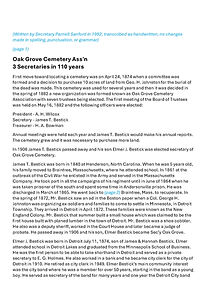
History of the Oak Grove Cemetery Association, Written by Secretary Parnell Sanford, 1992
Handwritten Version
(PDF, 6 pages)

Transcribed Version
(PDF, 3 pages)
Historic Timeline of the
Oak Grove Cemetery Association
1872
The New England Colony arrives in Detroit, Minnesota
Colonel George H. Johnston recruits Civil War veterans and their families from Boston. Among them: James T. Bestick, future founder of the cemetery association. The settlers become known as the New England Colony.
1874
Founding: The Town of Detroit establishes a cemetery committee
On April 24, 1874, the town appoints a committee tasked with securing land for a community burial ground. They purchase 10 acres from George H. Johnston — the same colonel who led the New England Colony to Detroit two years earlier. The first burials follow shortly after.
1882
Founding: Oak Grove Cemetery Association is formally established
Community leaders recognize the need for a permanent organization to govern the growing cemetery. Seven trustees are elected at the first annual meeting on May 16, 1882.
Officers: President A. H. Wilcox, Secretary James T. Bestick, Treasurer H. A. Bowman.
1906
Secretary James T. Bestick passes away; his son Elmer takes over
As the Association's first secretary, James T. Bestick served for 24 years. A Civil War veteran who survived Andersonville Prison, he came to Detroit, Minnesota, in 1872 and became a cobbler, deputy sheriff, court worker, and eventually a judge of probate. His son Elmer J. Bestick, born in Detroit in 1874, succeeds him as secretary.
1910
Elmer Bestick becomes City Clerk of Detroit, Minnesota
The first person in Detroit to master shorthand, Elmer serves as city clerk for 39 years until 1949. Alongside his civic duties, he serves as cemetery secretary for 46 years and is a band member for over 50 years — including a celebrated week-long performing at the Minnesota State Fair grandstand.
1940
Endowment fund formalized
After decades of difficult fundraising — including lean years asking lot owners for $2 annual donations and $50 perpetual care contributions — the association begins directing a portion of each lot sale into a permanent endowment fund. The Depression years made early fundraising especially challenging.
1952
Parnell "Sandy" Sanford becomes the third secretary in 70 years
When Elmer Bestick steps down after 46 years of service, his son-in-law Parnell "Sandy" Sanford takes the secretary's chair. Sanford inherits all records dating back to the association's founding in 1882 — a continuous archive now spanning seven decades.
Sanford, a Hawley, Minnesota, native and Dakota Business College graduate, Sanford begins a 45-year career at the bank in 1931. He would serve in the U.S. Navy 1942–1945 before returning to his position. In 1945 he marries Elmer Bestick's daughter, Elinor.
1963
Major cemetery expansion to the east
The association purchases a large parcel east of the existing grounds from Mrs. Edna M. Haas, significantly expanding the cemetery's capacity and securing its ability to serve the community for many generations to come.
1986
Clare Gibbons and Jan Lindsley begin digitizing burial records
Working from Secretary Sanford's records, headstone inscriptions, courthouse documents, and the Becker County Museum, the two volunteers compile a comprehensive burial database. After Clare Gibbons' passing at Christmas 1986, her daughter, Jan Lindsley, completes the project in 1991 — cataloguing approximately 6,500 burials by name, date of death, and grave location.
1989–1990
Theodore Lindbloom bequeaths his estate to Oak Grove
Theodore Lindbloom, a quiet single man who had purchased one modest burial lot, passes away July 3, 1989. His estate of $58,346 is left entirely to the nonprofit association he had quietly come to trust, a complete surprise to the trustees.
1990
New chapel and vault building constructed; roads resurfaced
The old chapel and vault building is demolished and replaced with a new structure ($31,240). All interior roads are resurfaced ($13,565). The endowment fund reaches $90,000, with only interest used for ongoing grounds care.
1992
Major landscaping project marks 110 years of service
New trees and shrubs are planted, fill dirt reshapes the entrance, and the last of more than 150 diseased elms are removed and replaced with green ash trees ($13,487). After 110 years, Oak Grove has had just three secretaries: James T. Bestick, Elmer J. Bestick, and Parnell E. Sanford.
Historical List of Past Oak Grove Cemetery Association Secreteries
Parnell E. Sanford (1952-199?, ?? years)
Elmer J. Bestick (1906-1952, 46 years)
James T. Bestick (1882-1906, 24 years)
Oak Grove Cemetery Association Articles
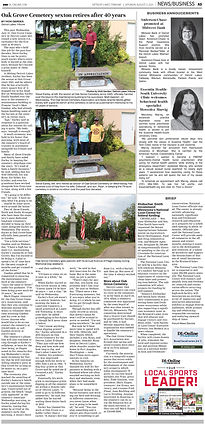
Oak Grove Cemetery Sexton Steve Earley Retires After 40 Years
Detroit Lakes Tribune | Saturday, August 3, 2024